
Mui Ne kitesurfing is at its best from November to March, when the northeast trade wind blows about 18–30 knots most days and peaks from January to March; from May to September a lighter southerly of 10–14 knots suits big kites and light-wind riders. The schools and the main launch are on the Ham Tien beach, about 6 km and 12 minutes by car east of The Cliff Resort & Residences at Phu Hai, so riders staying there take a taxi to each session.
A beginner needs roughly 9–12 hours of lessons, about EUR 500–660 at one IKO school in 2026.
Mui Ne wind by month, in knots
Two seasons shape every kite trip here. The northeast monsoon arrives in late October, builds through November and is strongest from December to February, usually filling in by mid-morning. Riders who know the coast call February and March the sweet spot: still reliable, a little less gusty. From May to September the trade wind gives way to a southerly that blows best in the late afternoon. April and October are the gamble months, when the wind can vanish for days.
| Month | Typical wind | Kite size (approx.) | Who it suits |
|---|---|---|---|
| November | 15–25 knots | 7–12 m | Lessons start, beach still quiet |
| December–January | 18–30+ knots, gusts to 40+ | 7–12 m | Confident riders; beginners in the mornings |
| February | 18–30 knots | 7–12 m | Everyone; the most reliable month |
| March | 15–25 knots | 7–12 m | Learners and improvers |
| April and October | 10–18 knots, patchy | 12–14 m | Flexible plans only |
| May–September | 10–14 knots | about 14 m | Light-wind riders, foilers, surfers |
Figures are typical ranges from kite guides published in May and July 2026, not a forecast. Check a wind app the week before you fly. For rain, sea temperature and the swimming months, see our Mui Ne weather guide.
Where to ride: Ham Tien and the spots beyond
Ham Tien, the main kite beach
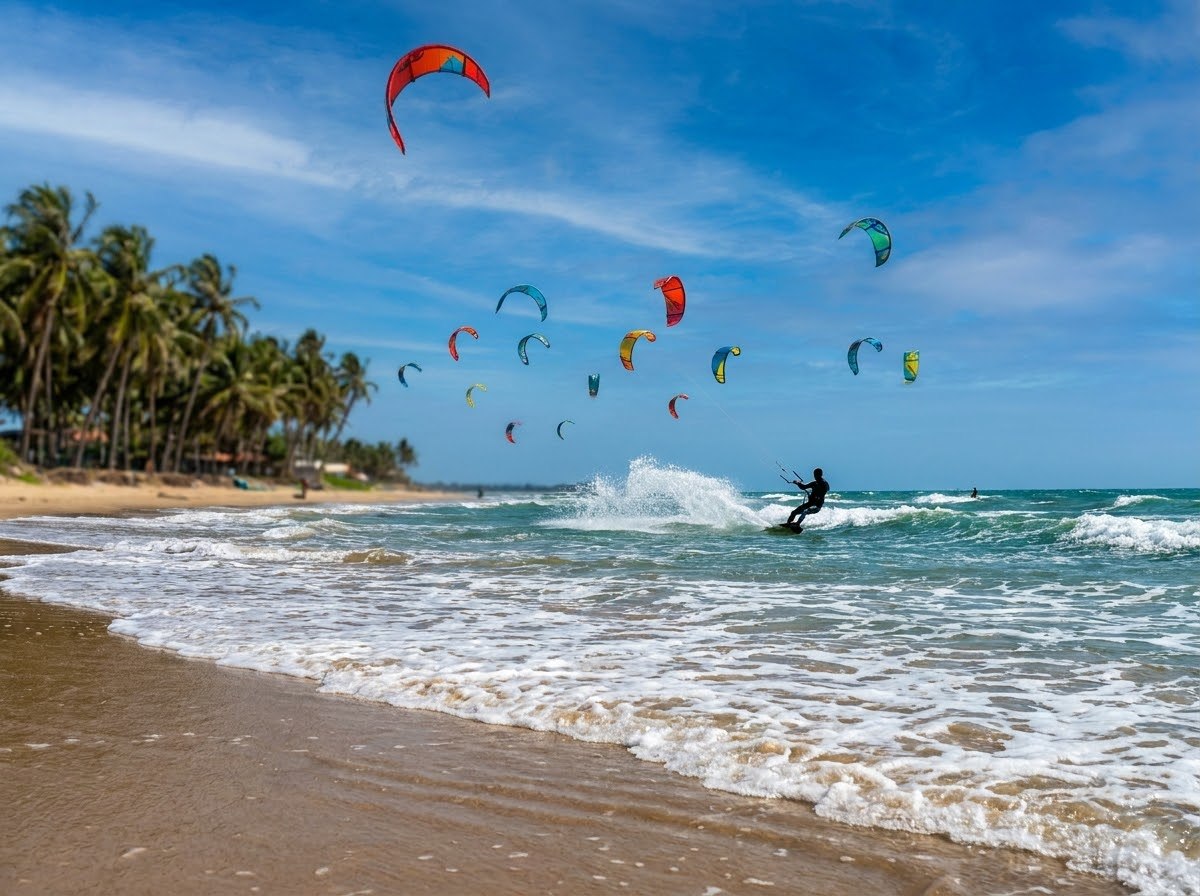
Almost every school launches from the main beach along the Ham Tien strip, a stretch of sand over a kilometre long lined with resorts and kite stations. Mornings are calmer and better for lessons; by the afternoon in high season the water is crowded. Stronger riders sometimes do the downwinder of about 15 km towards Phan Thiet. Just west of the main beach, the water inside the port wall is flat and at its best in the morning.
Malibu, Suoi Nuoc and the Cemetery
Further east, roughly 15–20 minutes beyond the main beach by road, Malibu beach has onshore wind and waves, more fun for wave riders and less forgiving for learners; take water shoes, as rubbish collects there. Suoi Nuoc, in the same bay, is more directly onshore. The Cemetery, with cross-offshore wind, rocks and a narrow beach, is for experienced riders only. Ask your school before riding any of these alone.
Lessons, courses and rental: 2026 prices
Most schools teach in hours, not days, because the wind decides when you ride. Guides in 2026 put a beginner at about 9–12 hours of tuition before riding on their own, which usually means three or four days of lessons. The table uses C2Sky’s published euro price list (checked October 2026) as one example, with the market range from a July 2026 guide.
| Format | Hours | Price (2026) | Notes |
|---|---|---|---|
| Taster, private | 2 | EUR 100 | C2Sky; try it before a course |
| Discovery course, private | 7 | EUR 385 | C2Sky; a first short course |
| Beginner course, private | 9 | EUR 495 | C2Sky; typical beginner length |
| Beginner course, two students | 9 | EUR 743 for both | C2Sky; shared instructor, slower |
| Full course, private | 12 | EUR 660 | C2Sky; where most students ride |
| Private hour, market range | 1 | USD 40–50 | July 2026 guide; some schools charge more |
| 10-hour IKO course, market range | 10 | USD 450–600 | July 2026 guide; usually over 5 days |
| Complete kite set rental | 1 h / day / week | EUR 38 / 100 / 400 | C2Sky; IKO card or equivalent needed |
What the price includes
At C2Sky, lesson prices include instruction and all the lesson equipment, and a lesson cancelled for lack of wind is moved and you pay only for the hours you complete. Rental covers accidental damage to the gear but not loss, so a kite that disappears downwind is your cost. Storing your own kit on the beach costs from about EUR 5 a day.
Choosing a kite school in Mui Ne
C2Sky Kite Center, at 12 Nguyen Dinh Chieu on the Ham Tien strip, has taught here since 2007, describes itself as an IKO and IWO certified school and runs a separate wing-foil centre elsewhere in Mui Ne. A May 2026 guide also lists Jibe’s Beach Club (teaching since 2000, with food and drinks on the sand), Vietnam Kiteboarding School at 10 Nguyen Dinh Chieu and Surfpoint at 16 Nguyen Dinh Chieu, which has showers, a café and a compressor. Prices and staff change from season to season, so contact any school before you go.
Questions to ask before you pay
Ask whether the instructor is IKO certified and teaches in your language, how many students share one kite, whether a rescue boat or jet ski is on the water, and what happens to unused hours if the wind drops. A school that answers all four clearly is usually a safe choice.
Beginner or experienced rider?
Beginners should book lessons for the mornings in November, February or March, when the wind is steady but not at its December peak. Experienced riders can rent on the strength of an IKO Level 3 card or equivalent, or bring their own gear and pay a school for storage. Airlines usually charge extra for a kite bag, so ask yours before you pack.
Safety on a crowded kite beach
In high season the Ham Tien beach can hold dozens of kites at once, and not every rider follows the right-of-way rules, so give learners plenty of room and use the launch and landing areas marked by the kite stations. Wear a helmet and an impact vest, ride with an instructor for your first 6–10 hours, and do not take offshore wind lightly. December and January gusts can top 40 knots, which is more than many intermediate riders can handle.
Insurance matters as much as the helmet. Many standard travel policies exclude kitesurfing or cap cover for it, so read the wording or buy a watersports add-on before your first lesson.
From The Cliff to the kite beach, and what non-riders can do
Getting there with or without gear
The Cliff is on the coast road about 6 km west of the Ham Tien strip, and the road has no pavement, so riders go by Grab or taxi; the trip takes about 12 minutes. A lesson needs no gear of your own. If you bring a board bag, order a seven-seat car, and store the kit at your school to avoid the daily run. Whether the resort can store kite gear is on request — ask the hotel when you book. For the drive down from Ho Chi Minh City, see our journey guide.
The Cliff’s own beach
The resort beach hosted a kite festival on 2 May 2026, but day-to-day lessons and rental happen on Ham Tien, not here. In the windy months the flags often keep swimmers near the shore, and the free one-hour kayaks are better saved for calm mornings. Tour operators list paid windsurfing and jet skis on the beach; check with the hotel whether they run in your dates.
For partners and children
Non-riders can watch from the beach bars on Ham Tien, try a surf lesson when the wind is light, or stay at the resort: the smaller second pool on a lower deck is more sheltered on gusty afternoons, and the kids club is free for ages about 2 to 11. Our facilities guide covers the pools, spa and beach in detail, and things to do in Mui Ne lists the dunes and day trips.
Questions about Mui Ne kitesurfing
How many hours of lessons does a beginner need in Mui Ne?
Most schools say 9 to 12 hours before a beginner rides short distances on their own, and C2Sky notes that most of its students start riding at around 12 hours. Allow three or four days, plus a spare day in case the wind drops.
Do I need an IKO card to rent a kite in Mui Ne?
Usually yes. Schools generally ask for an IKO Level 3 card or an equivalent from another body before they rent kit on its own. Without one, book a supervised refresher hour first; C2Sky lists one at EUR 60 in 2026.
Can you kitesurf in Mui Ne in summer?
Yes, but it is a different sport. From May to September the southerly wind blows about 10 to 14 knots, best in the late afternoon, so you need a big kite of about 14 m or a foil. Beginners progress faster in the stronger, steadier winter wind.
Can I store my own kite at the beach?
Yes. Kite stations on Ham Tien offer day or overnight storage; C2Sky lists storage from EUR 5 a day in 2026. That saves carrying wet gear in a taxi between the beach and The Cliff every day.
Wind ranges, lesson and rental prices from May–October 2026 school and guide listings; distances and drive times checked October 2026.